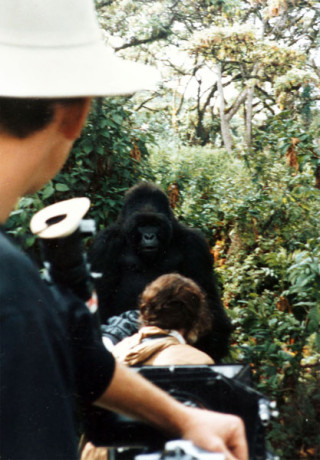
Point of view scene. Bob Campbell (Brian Brown) filming Dian (Sigorney Weaver) with Digit. John Alexander in Digit suit. Photo by Camilla Henneman
A small crew from Rick Baker’s shop went on location to shoot the gorilla suits and puppets. The live action footage of real gorillas being gorillas and interacting with Sigourney had been previously shot at the Karasoke Research center in Rwanda. The editor, Stuart Baird had the difficult task of editing scenes of the real gorillas with footage of the actors in gorilla suits. Scenes with dialogue were shot to tie the story together. Any scene that had dialogue or gorillas acting would be done with actors in gorilla suits. Most of the outdoor scenes were shot in Kenya. Interiors were shot at Shepperton Studios in London.

Dressers with baby gorilla puppet Photo by Camilla Henneman
The gorilla suit crew that went to Africa consisted of, Rick Baker, Phil Notaro, Dave Kindlon, Tom Hester, Angela Alexander, Stuart Artingstall and me. The Kenya location in Aberdare National Park was chosen for its resemblance to Virunga. We filmed in summer, but since we were at 13,000 feet in altitude, the temperature during the day averaged in the 50s. Nights were cold and wet. The park was a lion preserve, and though lions will usually try to avoid humans, the production included dogs and chickens which we were told might attract lions to our camp. July is the driest season, but it still rained almost every day. Many times we had to get out of our vehicles and push them.

Setup for scene with baby gorilla played by chimpanzee. Photo by Camilla Henneman
Accommodations were supplied by a safari company. We slept on cots in a tent with an open coal fire for heat. The safari company constantly reminded not to fall asleep with the fire burning, lest we succumb to carbon monoxide poisoning. Toilets were port-a-potties, and showers were 5 gallon buckets with the water heated over a flame.

My tent Photo by Camilla Henneman
The first night we arrived, I lay on my cot and listened to the sounds of snarling and bellowing. One of the safari attendants poked his head in and told me that we were hearing the sound of lions killing a buffalo. He assured me that was a good sign as the lions would be gorging themselves for days and would not be interested in us. Later, the safari crew dragged the dead buffalo down the road a few hundred yards away from our camp. Over the next few days drivers would take crew members to the kill site to watch the lions feed.

Rick Baker and Angela Alexander preparing Digit for scene with Sigorney Weaver. Photo by Camilla Henneman
Although the Kenya location was chosen partly for its distinctive moss covered trees, when we arrived there was no moss. The seasons had changed since the location was scouted. One of the scenes we shot was in sight of our camp. To prepare shooting the greensman (plant wrangler) went in early to staple moss to the trees for the scene. Rangers with rifles accompanied him. If lions were present, the rangers were supposed to shoot to scare, but not hit lions. As we were getting actors into their gorilla suits, we heard rustling and shouting from the trees in front of us. The rangers came stumbling out of the trees shooting off their rifles and yelling something about lions. A few minutes later the greensman came out alone. We were told that the film crew surprised two lionesses with their cubs. The greensman stood his ground , shouting and waving branches. The lions left. I was much more concerned about the rangers with rifles, than I ever was about lions.

Photo by Camilla Henneman

Simba death scene (Peter Elliot) on mechanical tree. Photo by Camilla Henneman
There were two gorilla death scenes that we shot in Kenya. The first was the death of “Simba” This scene showed poachers chasing down and killing a mother gorilla to capture her baby. At the climax of the scene, the Batwa tribesmen chase the mother gorilla, “Simba” up a tree. They chop the tree down to trap her. In order to have control over the tree fall, a mechanical tree that could be felled repeatedly was built. Gorilla actor, Peter Elliot was on the tree when it was “cut down” over and over. Peter sustained some pretty bad bruising in the falls, but stuck with it until they got adequate coverage of the shot.

Rona Brown and Stewart Artingstall attaching baby gorilla puppet to Simba’s back. Photo by Camilla Henneman
In the scene, all the gorillas were killed except the baby. The first baby is a dummy puppet which is attached to the actor’s back. After the Batwa kill Simba and carry off the baby , it is a chimpanzee in a gorilla suit. The chimp was very scared, and bit the actor carrying it.

Baby gorilla puppet heads. Photo by Camilla Henneman
The scene for Digit’s death required an elaborate set up. In the scene a spear was thrown into Digit’s side. The stunt was done practically with the actor, John Alexander, in the Digit suit. A wooden block with a cable attached was sewn into the side of the muscle suit. For the scene, one of the stunt crew threw the spear which was on a cable to guide it into the wood block. It looked like the spear was thrown into Digit. Later, in London an actor was filmed throwing the spear.
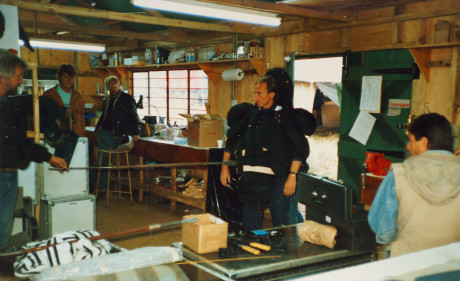
Digit’s death setup. Stunt coordinator setting up the spear rig. Photo by Camilla Henneman

Fatal throw coverage filmed in London. Photo by Camilla Henneman
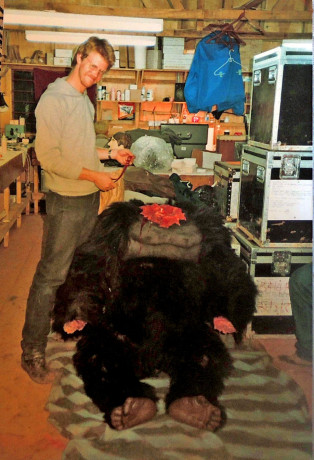
Tom Hester applying strips of gelatin blood to Digit’s decapitated body dummy. Photo by Camilla Henneman
In the film, the Dian and her assistants find Digit’s maimed body. The captors had cut off Digit’s head, hands, and feet. To do this scene, our crew made strips of “blood” using gelatin and pigments and draped them over a foam dummy of Digit wearing the hair suit.
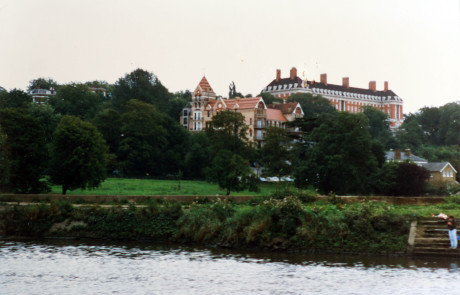
We left Africa to go to London where the interior scenes were shot. Our accommodations were as plush in London as they were primitive in Kenya. We Stayed for 2 months at The Petersham. It was quite a bit like Downton Abbey.
Scenes with Dian and the baby gorilla she rescues were shot in London. The schedule was getting tight as we had to film everything with the puppets before we returned to the states. The production needed coverage of Dian removing a baby gorilla (puppet gorilla) from its cage in the poacher’s van. Sigourney Weaver was busy with the main unit, so it was decided to shoot the scene with me doubling for Sigourney. For a brief time, I got to play Dian Fossey.

Camilla doubling for Sigorney Weaver in puppet scene.

Steve Norrington and Stuart Artingstall with baby gorilla puppet. Photo by Camilla Henneman
The film came out in 1988. We had been told that if we were successful, no one would know that we had done anything. More than a hundred brilliant sculptors, mechanics, costumers, and puppeteers were uncredited for their work. The small group that went to Kenya were the only ones given screen credit. Sadly, this was very divisive to the crew.
In the 1993-94 Rwandan genocide, the mountain gorillas lost their protectors. It was feared that they might not survive as groups of people fleeing the slaughter moved into the gorilla sanctuary. A group of 31 “gorilla tourists” was kidnapped slaughtered by Hutu militia, and 8 were slain. Some of the mountain gorillas succumbed to illness and for awhile their numbers dwindled to less than 300. In recent years the population has recovered and recently more than 800 mountain gorillas have been counted.

Photo of the Digit Suit. Photo by Camilla Henneman
The true murderers of Dian Fossey have never been brought to justice.
I will leave you with a video from Ricks shop. In the beginning, the sculptors are at the LA zoo, sculpting gorillas using a baby gorilla there as a model.
Following that is footage of some gorilla puppet tests. Video by Marc Tyler.
https://www.youtube.com/watch?v=zDkyq0T0hfs&feature=youtu.be